Week 8: Protecting Your Human Capital
Everything we've covered so far assumes one thing is still working: you. I call it human capital, and for most of you, it's one of the largest assets on your balance sheet, even though it rarely shows up on a net worth statement.
Today I want to talk through how to think about that number, and then talk about a tool that protects it: insurance.
Human Capital: The Calculation
Let's start with how I frame this, because it changes how seriously people take the rest of the conversation.
For many of you, carry might be one of the largest numbers on your balance sheet, but your future income may rival it. Future income is likely more predictable than carry, as carry numbers can change dramatically based on fund performance. When thinking about insuring the largest assets within your financial structure, it's also far more common, and far more realistic, to insure your income than your carry.
Here's the simplest way I can put it: if you can't get up and go to work every day, you need your money to get up and go to work for you instead. Everything in insurance planning flows from that one idea.
And as a PE professional, this hits differently than it does for most people. As a high-income earner, you may have greater income-replacement needs and greater potential liability exposure. So here's how I actually calculate your human capital:
Start with current income: base plus a realistic bonus number
Project that forward to your expected retirement age
Apply a discount rate that reflects the uncertainty in that income to bring it back to today’s dollars
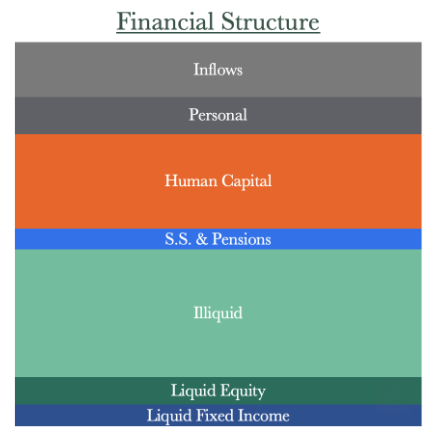
If you’ve been following along with this series, I go into quantifying your human capital and how it relates to your overall financial structure in more detail here. This is the number insurance exists to protect.
Disability Insurance
Start with disability, because it's the piece I find gets neglected the most in a financial plan.
I'll say this directly: it's ok to be selfish here. This is the one that impacts you directly if something happens. Life insurance kicks in if you die, but with disability, you're still here. Disability is the risk that takes away your ability to keep generating income. It's arguably harder to plan around than death, because the expenses don't stop and now there's a person who needs support and can no longer earn.
Many of you have disability coverage through your firm, but employer-provided benefits may replace only a portion of your income, particularly if compensation includes a significant bonus or other variable pay. It is also important to review how the policy defines disability, along with any benefit caps, waiting periods, exclusions, and portability limitations. For professionals whose income depends on a specialized skill set, the distinction between an own-occupation definition and a broader occupational standard can materially affect when benefits are payable. The right coverage depends on your individual circumstances, existing benefits, and the policy terms.
Life Insurance
Life insurance is the more familiar piece, but the decision that trips people up is “term” versus “whole life”.
In basic terms, term is pure protection for a defined period, matched to a specific need. Whole life insurance is designed to provide lifetime coverage and serves a different purpose - things like estate liquidity or wealth transfer. They're not competing products, they're different tools for different jobs.
When I think about an appropriate death benefit number, I prioritize income replacement. Here's a way to think about why that matters: if something happened to you, part of what you're replacing is the value of everything you and your spouse do for your family day to day, right down to effectively hiring a full-time stay-at-home parent to hold that together. That's a real cost, and it belongs in the number.
I also know most of you are analytical types, and this is a place where the analytics only get you partway there. How much insurance you really need isn't just a spreadsheet exercise, it has to balance analytics with emotion. The person purchasing the policy is not always the one who's impacted if it's ever used. You have your own risk tolerance, but this decision isn't only about your risk tolerance, it's about your spouse's and your kids'.
One more wrinkle specific to the private equity industry: a lot of you reach financial independence earlier than most people ever will. That changes the insurance conversation, because at a certain point your assets, not a policy, are what's actually protecting your family, and the plan needs to reflect that shift rather than defaulting to whatever coverage you bought at 28.
And that shift can happen faster than you'd expect. If fund performance is strong, your net worth doesn't creep up gradually, it can increase significantly over a relatively short period, and your insurance needs change right along with it. This is why I'll sometimes see people ladder their term policies, buying several with different term lengths so the coverage steps down at different stages of their career instead of falling off a cliff all at once. The idea is that as your asset base grows, you increasingly become able to self-insure, so the coverage you need in your 30s isn't the coverage you need in your 50s. There's no single right way to structure this, which is exactly why it helps to work with someone who understands your industry, your personal situation, and your finances, rather than applying a generic rule of thumb.
Long-Term Care Insurance
Long-term care is a slightly different animal, because for a lot of you the pure math argument doesn't hold up the same way it does for disability or life.
As a rough rule, once a household has cleared a certain threshold of liquid investable assets, it may be able to self-fund some or all long-term-care expenses, depending on expected costs, longevity, liquidity needs, and family circumstances.
So the question becomes - why do some people well past that threshold still buy long-term care coverage?
Because it's not only a funding question, it's a caregiving question. A policy can sometimes come with more than a check. Some policies may include care-coordination or related support services, depending on the carrier and policy terms. If you don't have people around you who can step in and help manage the logistics, that coordination has real value even when the dollars themselves aren't the constraint.
P&C and Umbrella
Last piece, and it's the one people think about the least: property and casualty, specifically umbrella coverage.
Your human capital and your balance sheet can create liability exposure that is easy to underestimate. A car accident, an incident at your home, or something involving your kids can result in damages that exceed the limits of your underlying insurance.
I’ll use the example of texting while driving here, because that's the scenario that actually happens to normal people, not some exotic liability event.
Picture this: you glance down at a text and rear-end someone at a stoplight, and the other driver is seriously injured. During the claim process, the other side may learn more about your occupation and financial circumstances. If the damages exceed your auto policy’s liability limits, your personal assets could be exposed to the remaining amount.
That’s the gap umbrella coverage is designed to help address. It generally sits on top of qualifying auto and homeowners liability coverage and provides an additional layer of protection, subject to the policy’s limits, exclusions, and required underlying coverage.
Final Thoughts
The theme across all of this is the same one from the debt conversation last week. You've built something real on your balance sheet and in your career. This next stretch of the series is about protecting it, and insurance, done thoughtfully, is one tool for transferring selected financial risks that a household does not wish to retain.
I'm not here to tell you to insure every aspect of your life. It's worthwhile, though, to think through the vulnerabilities in your life that have the potential to create an outsized impact on your financial future.
Important Disclosures:
The information provided is for educational and informational purposes only and does not constitute investment advice and it should not be relied on as such. It should not be considered a solicitation to buy or an offer to sell a security. It does not take into account any investor's particular investment objectives, strategies, tax status or investment horizon. It does not take into account any investor's particular investment objectives, strategies, tax status or investment horizon. Axiom Private Wealth, LLC. does not provide tax or estate planning advice. Please consult with your tax advisor or attorney. The views expressed in this commentary are subject to change based on market and other conditions. These documents may contain certain statements that may be deemed forward‐looking statements. Please note that any such statements are not guarantees of any future performance and actual results or developments may differ materially from those projected. Any projections, market outlooks, or estimates are based upon certain assumptions and should not be construed as indicative of actual events that will occur. All information has been obtained from sources believed to be reliable, but its accuracy is not guaranteed. There is no representation or warranty as to the current accuracy, reliability or completeness of, nor liability for, decisions based on such information and it should not be relied on as such. Axiom Private Wealth, LLC (“Axiom”) is a registered investment advisor. Advisory services are only offered to clients or prospective clients where Axiom and its representatives are properly licensed or exempt from licensure. For additional information, please visit our website at http://www.axiomprivatewealth.com/. For current Axiom information, please visit the Investment Adviser Public Disclosure website at www.adviserinfo.sec.gov by searching with Axiom’s full legal name or CRD #307388. Axiom and its advisors do not provide legal, accounting, or tax advice. Consult your attorney or tax professional. Representatives have general knowledge of the Social Security tenets. For complete details on your situation, contact the Social Security Administration.
Risk Disclosure
No investment strategy or risk management technique can guarantee returns or eliminate risk in any market environment. Asset Allocation may be used in an effort to manage risk and enhance returns. It does not, however, guarantee a profit or protect against loss. Increase in real interest rates can cause the price of inflation-protected debt securities to decrease. Interest payments on inflation-protected debt securities can be unpredictable. Although bonds generally present less short-term risk and volatility risk than stocks, bonds contain interest rate risks; the risk of issuer default; issuer credit risk; liquidity risk; and inflation risk. All investments include a risk of loss that clients should be prepared to bear. The principal risks of Axiom’s strategies are disclosed in the publicly available Form ADV Part 2A