You Don’t Need to Win Every Point
This Fourth of July marks the 250th anniversary of America’s independence. I’m proud to be an American and especially grateful for the freedom, opportunity, and responsibility that come with it. Given the short week, I wanted to keep this note fun and light.
I spent an embarrassing amount of time trying to build this week's note around Joey Chestnut. Something about consistency, showing up every year, putting away 70-plus dogs like clockwork. I couldn't make it work. Turns out competitive eating and long-term investing have less in common than I hoped.
So we're going with tennis instead. It's also the start of Wimbledon, which gives me a much better story.
I first heard a version of this market-and-tennis comparison from Dimensional Fund Advisors, one of our investment partners, and it has stuck with me.
I talk a lot about drowning out the noise. The daily market chatter, the headlines, the urge to react. It's easy to say and hard to do. So this week I want to show you why it works, with numbers instead of words.
Start with a single day in the market. A coin toss, basically. The market finishes positive about 53% of days and negative about 47%. Not much of an edge.
Now stretch the window out. On a quarterly basis, 70% of quarters are positive. Go all the way out to a full year, and 78% of years are positive. Same market. The only thing that changed is how long you were willing to wait.
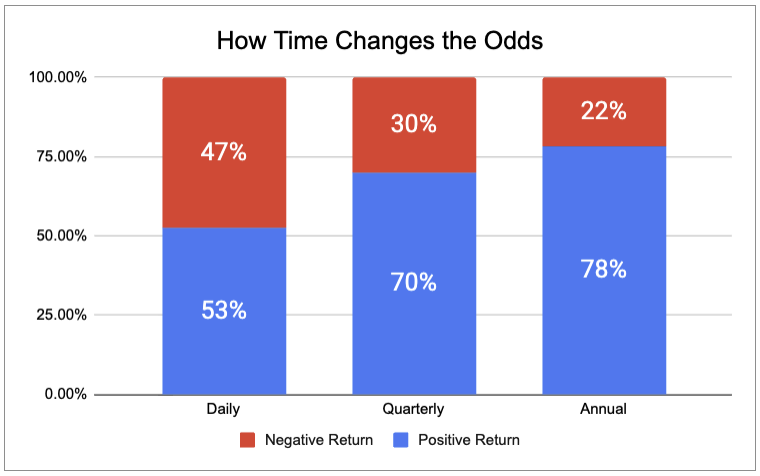
S&P 500 Index from 01/01/1966 to 05/31/2026.
Daily Source: YCharts
Quarterly & Annual Source: Dimensional Fund Advisors, Returns Web.
The longer your time frame, the more the odds tilt in your favor.
Now here's the connection to tennis. Roger Federer, one of the greatest to ever play, won only about 54% of the points across his career. Just over half. But he won roughly 76% of his sets, and 82% of his matches.
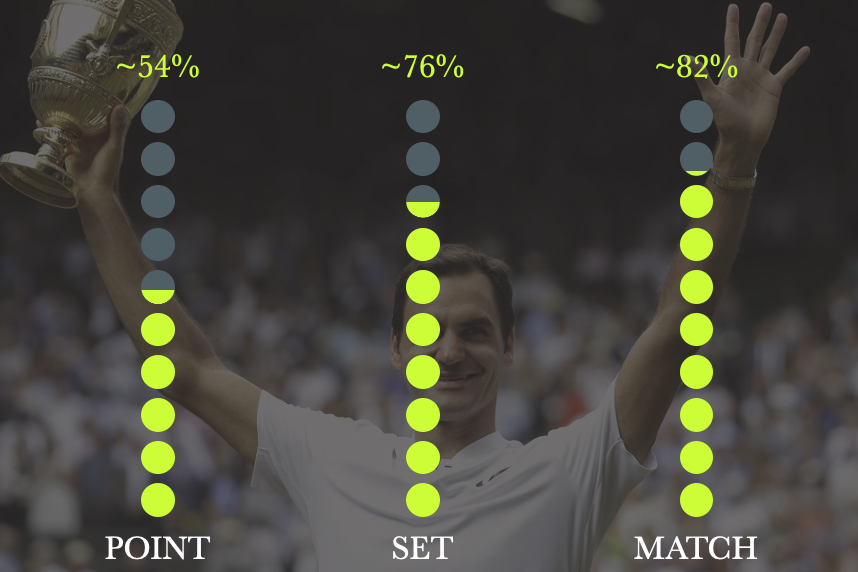
Source: https://www.ultimatetennisstatistics.com/playerProfile?name=Roger%20Federer&tab=statistics
Look at those numbers together. Daily, quarterly, yearly. Point, set, match. They line up pretty nicely.
Here's why I'm telling all of you this in particular. You already know this discipline. You live it every day in your funds. You underwrite to a hold period and manage to an outcome. The interim noise is just noise.
Part of what makes that easier is something we rarely give credit to: you can't easily check the price. A fund doesn't quote you a number every second. Neither did your house, until the last ten or fifteen years (thanks to Zillow). That lack of a real-time price feels like a limitation, but it's quietly one of the most valuable things about private assets. The illiquidity protects you from yourself.
The hard part is applying that same patience to the public side of your balance sheet, where the prices update every second and the temptation to react never stops.
The portfolio that holds your liquidity does not need to win every day. It needs to stay in the game long enough for the odds to do their work.
Or, as Roger Federer would put it: you don't need to win every point. You need to stay in the game and keep playing.
Important Disclosures: Axiom Private Wealth, LLC (“APW”) is a registered investment advisor. Advisory services are only offered to clients or prospective clients where APW and its representatives are properly licensed or exempt from licensure.
The information provided is for educational and informational purposes only and does not constitute investment advice and it should not be relied on as such. It should not be considered a solicitation to buy or an offer to sell a security. It does not take into account any investor's particular investment objectives, strategies, tax status or investment horizon. You should consult your attorney or tax advisor.
The views expressed in this commentary are subject to change based on market and other conditions. These documents may contain certain statements that may be deemed forward looking statements. Please note that any such statements are not guarantees of any future performance and actual results or developments may differ materially from those projected. Any projections, market outlooks, or estimates are based upon certain assumptions and should not be construed as indicative of actual events that will occur.
All information has been obtained from sources believed to be reliable, but its accuracy is not guaranteed. There is no representation or warranty as to the current accuracy, reliability or completeness of, nor liability for, decisions based on such information and it should not be relied on as such.
Past performance shown is not indicative of future results, which could differ substantially.